
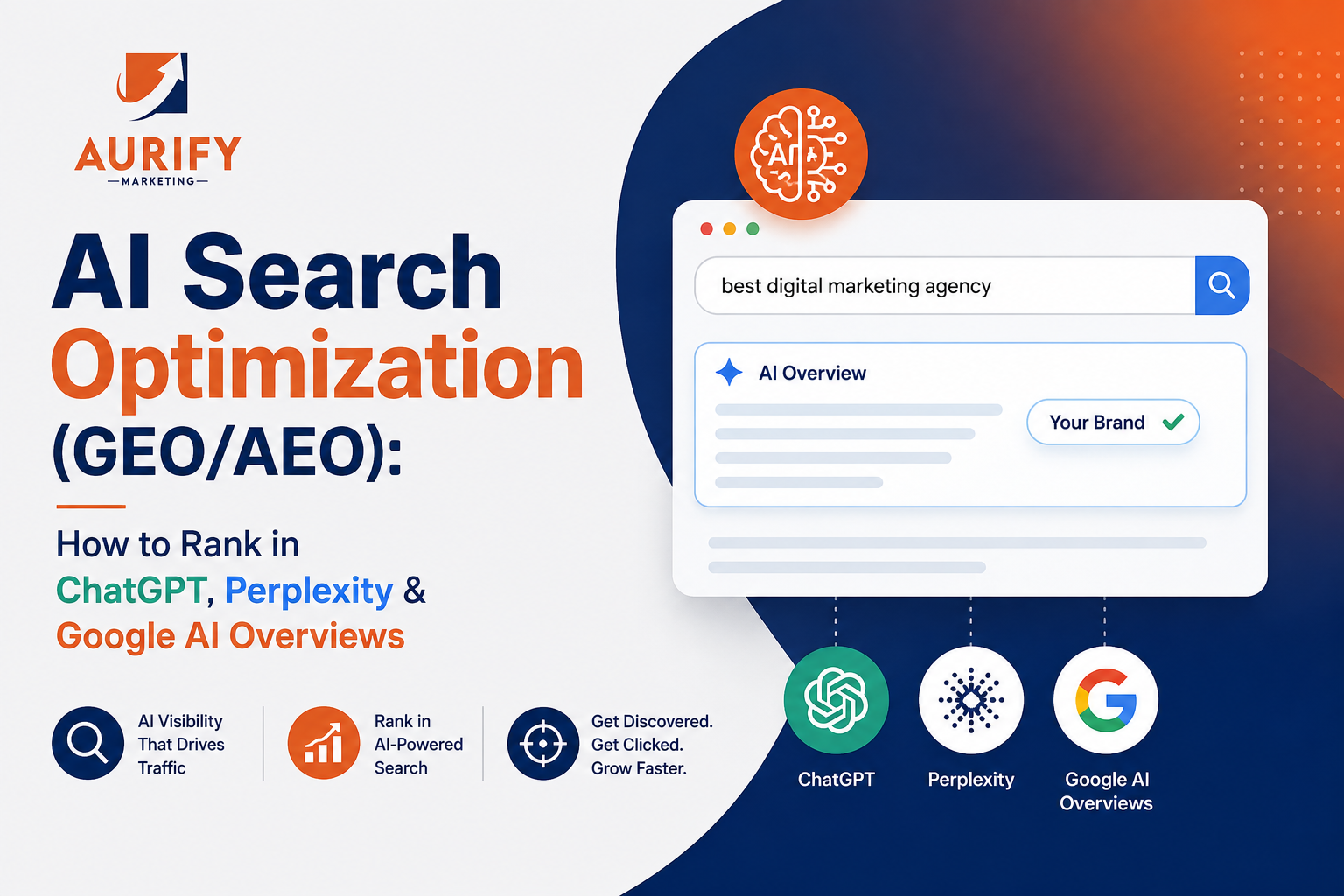
AI Search Optimization (GEO/AEO) is no longer a future consideration for businesses that depend on search traffic. It is the reason some brands keep showing up inside ChatGPT answers, Perplexity summaries, and Google AI Overviews while their competitors quietly disappear from the conversation. If you run a business and your customers are asking questions to AI tools before they ever type a query into Google, the way you get discovered has already changed. This guide breaks down what GEO and AEO actually mean, how each AI platform decides who gets cited, and what your business needs to do this quarter to stay visible and start converting that visibility into leads.
What AI Search Optimization Actually Means for Your Business
AI Search Optimization is an umbrella term that covers two closely related disciplines: Generative Engine Optimization (GEO) and Answer Engine Optimization (AEO). GEO focuses on making sure AI systems like Google AI Overviews, Gemini, and Copilot describe your brand accurately once they decide to include you in a generated answer. AEO focuses on structuring your content so that platforms built to answer questions directly, including ChatGPT and Perplexity, can extract, trust, and cite your page as the source behind that answer.
The distinction matters because the two disciplines reward slightly different things. GEO leans on entity authority, meaning how well-established and consistently described your brand is across the web. AEO leans on content structure and clarity, meaning how easily a system can pull a clean, accurate answer out of your page without misquoting you. According to CXL’s guide on Answer Engine Optimization, the shift here is from optimizing purely for clicks to optimizing to become the source that actually powers the answer itself. Meltwater’s breakdown of AEO makes a similar point: your goal is no longer just ranking high on a results page, it is being quoted, summarized, or spoken by the engine itself.
Both disciplines sit on top of traditional SEO. Google has said directly, through its own Search Central documentation, that AI Overviews and AI Mode are not running on a separate system with separate rules. The same fundamentals that earn you a page-one ranking are what allow you to be pulled into an AI-generated answer. GEO and AEO are refinements on top of that foundation, not a replacement for it.
If your current SEO strategy still treats ranking as the finish line, this is the point where that thinking needs to change.
Why This Shift Is Already Costing You Customers
Google’s AI Overviews now reach an estimated 2.5 billion monthly users, and that surface sits above the traditional blue links on a growing share of search queries. Research cited in industry reporting on 2026 search trends puts the average click-through decline on the top organic result at around 34.5 percent once an AI Overview appears on that query. That is not a rounding error. That is a third of the clicks a page used to earn, gone before a user even scrolls down.
At the same time, search volume itself keeps climbing. SparkToro’s research shows Google still processes roughly 14 billion searches a day against ChatGPT’s estimated 37.5 million, a gap of more than 370 to 1. The takeaway is not that Google is being replaced. It is that the way people consume search results inside Google has changed, and a second, fast-growing channel now sits alongside it in the form of conversational AI tools.
For a business owner, this creates a two-front problem. You need to keep earning organic rankings the traditional way, and you now also need your content structured well enough to be pulled into the AI-generated answer sitting above those rankings, or referenced when someone asks ChatGPT or Perplexity the same question instead of Googling it. Businesses that treat this as optional are handing that visibility to competitors who do not.
How Google AI Overviews Actually Decide What to Show
Google’s own AI Features documentation explains that AI Overviews and AI Mode often use a technique called query fan-out. Instead of answering a query with a single search, the system issues multiple related searches across subtopics and data sources, then synthesizes a response from what it finds. This means a single page rarely gets cited because it happened to rank for the exact phrase someone typed. It gets cited because it answers one specific sub-question inside a broader topic cluster clearly and accurately.
Google has also been explicit that spam policies now apply to AI-generated responses the same way they apply to standard rankings. If a page was previously demoted for thin content, scaled AI content abuse, or site reputation issues, it is excluded from the AI citation pool as well. There is no separate, easier path into AI Overviews for lower-quality content. If anything, the bar for what gets cited is tightening as Google works to keep expired domains and thin affiliate pages out of AI-generated answers.
What actually helps, according to Google’s guidance, comes down to the same E-E-A-T principles the company has recommended for years: experience, expertise, authoritativeness, and trustworthiness. Content that leads with a clear answer, uses descriptive headings, and separates distinct claims into clean structural sections is easier for any synthesis system to extract correctly. Structured data, including Article, FAQ, HowTo, and Organization schema, gives Google’s systems machine-readable context that supports that extraction, even though Google has stated there is no special markup required specifically for AI Overviews.
How ChatGPT and Perplexity Select Sources Differently From Google
ChatGPT and Perplexity are not running Google’s indexing system, so the rules shift slightly. These platforms typically rely on retrieval-augmented generation, pulling from a mix of their own training data, live web retrieval, and in Perplexity’s case, real-time citations pulled directly from crawled pages during the response.
Perplexity, in particular, behaves closer to a citation engine. It actively pulls from a handful of sources per answer and displays them as numbered references, which means being one of those three to five sources for a given query has direct value. ChatGPT’s web-browsing and search-enabled modes work similarly when a user’s query triggers a live lookup rather than relying purely on the model’s training knowledge.
For both platforms, the sources that get pulled tend to share a few traits: clear, direct answers near the top of the page, content that reads naturally rather than as keyword-stuffed copy, and a track record of being cited or linked elsewhere, which signals to the retrieval system that the source is trustworthy. This is why entity authority, meaning consistent, accurate information about your business across your own site, your Google Business Profile, review platforms, and industry directories, carries real weight. If an AI system cannot easily confirm who you are and what you actually do, it will default to a competitor it can verify more easily.
The Core Pillars of GEO and AEO That Actually Move the Needle
Answer-First Content Structure
Every page targeting a specific question should answer that question within the first sixty to one hundred words after the relevant heading. This does not mean stripping out depth. It means putting the direct answer first, then following it with supporting detail, examples, and context. AI systems extract the clearest, most self-contained passage they can find. If your answer is buried three paragraphs deep under a personal anecdote, you are making the system work harder to find it, and it will often just cite a competitor who made it easier.
Entity Authority and Consistency
Your business name, service descriptions, location, and credentials need to match across your website, your service pages, your Google Business Profile, and any directory or press mention that references you. Inconsistent information across these sources weakens the confidence any AI system has in citing you accurately. This is also where a documented case study or client result carries more weight than a vague claim, because it gives the system something specific and verifiable to reference.
Structured Data and Schema Markup
FAQ schema, Article schema, and Organization schema give search engines a machine-readable layer that reduces ambiguity about what your page is and what it is answering. Nesting FAQ schema inside Article schema, where relevant, has become a standard technical practice heading into 2026 because it gives AI systems a cleanly formatted question-and-answer structure they can lift directly.
Topical Depth Instead of Keyword Density
Traditional SEO rewarded repeating a keyword phrase enough times to signal relevance. AI systems work differently. They understand synonyms, related concepts, and general meaning without needing exact-match phrasing repeated throughout a page. What matters more is whether your content covers a topic thoroughly enough that an AI system can pull multiple sub-answers from it without needing to stitch together information from three other sites. A single, well-researched page that fully answers a topic will outperform five thin pages targeting keyword variations of the same idea.
Multi-Platform Brand Presence
AI systems increasingly cross-reference more than your website. Community platforms, review sites, industry publications, and even social profiles feed into how confidently a system can vouch for your business. A brand that only exists on its own website looks thinner to an AI system than one with a presence across multiple verified, independent sources.
A Practical Framework to Start Getting Cited This Quarter
The first step is an audit of your existing content against real questions your customers ask AI tools today, not the keyword list you built two years ago. Pull the actual phrasing people use when they ask ChatGPT or Perplexity about your industry, then compare that against what your current pages answer. Most businesses find a wide gap here, because their content was written for search engines parsing keywords, not for a system trying to lift a direct answer.
The second step is restructuring your highest-intent pages so the answer sits at the top, supported by clear H2 and H3 headings that map to the actual sub-questions a buyer would ask. This includes your service pages, comparison content, and pricing information. If someone asks an AI tool what your pricing looks like or how your service compares to an alternative, that answer needs to exist on your site in a directly citable format, not buried in a PDF or a sales call.
The third step is implementing schema markup properly across your key pages, particularly FAQ and Organization schema, so that both Google’s systems and third-party AI crawlers have a clean, structured version of your content to reference.
The fourth step is building out topic clusters instead of isolated blog posts. A single pillar page supported by several deeply linked subtopic pages performs better in AI synthesis than a scattered content calendar with no internal linking logic. This also improves your standard organic rankings, since Google’s algorithm rewards the same topical depth.
The fifth step is monitoring citation frequency across platforms, not just organic rankings. Track how often your brand shows up when you or your team ask ChatGPT and Perplexity the questions your customers are likely asking. This is a manual process right now for most small and mid-sized businesses, but it is the only way to know whether your GEO and AEO work is actually landing.
Common Mistakes That Keep Businesses Invisible in AI Search
The most common mistake is assuming that traditional keyword optimization automatically transfers to AI visibility. It does not. A page that ranks on page one for a keyword can still be completely absent from an AI-generated answer if the content is not structured to be extracted cleanly.
The second mistake is chasing exotic technical fixes, such as assuming an llms.txt file will guarantee inclusion in Google’s AI Overviews. Google has stated plainly that llms.txt files are not used by its systems. That does not mean the file has zero value everywhere, since some third-party AI crawlers do reference it, but treating it as a shortcut into Google’s AI Overviews is a wasted effort based on a misunderstanding of how the system actually works.
The third mistake is publishing thin, AI-generated content at scale in the hope that volume alone improves citation odds. Google has confirmed that its spam policies now explicitly apply to AI-generated search responses, which means low-quality, mass-produced content is more likely to get filtered out of the citation pool than rewarded for existing.
The fourth mistake is ignoring off-site authority entirely. A business that only invests in its own website, without building consistent, accurate mentions across directories, review platforms, and industry sources, gives AI systems less confidence to cite it, regardless of how well the on-site content is structured.
Why Most Businesses Cannot Execute This Alone, and Why That Is Fine
GEO and AEO require a combination of technical schema implementation, content strategy, competitive research into what AI tools are already citing for your industry, and ongoing monitoring across platforms that did not exist as SEO channels three years ago. Doing this properly alongside running a business is a genuine time cost, and getting the technical implementation wrong can waste months of effort with no visible payoff.
This is exactly the gap our SEO consultancy work at Aurify Marketing is built to close. We combine the technical schema and structured data work, the content restructuring needed for answer-first formatting, and the entity authority building across directories and platforms that AI systems reference when they decide who to cite. Our approach treats AI Search Optimization as an extension of a strong SEO foundation, not a separate project running in parallel with no connection to your existing rankings.
What This Looks Like When It Is Done Right
A business that gets this right shows up in three places at once: the traditional organic result, the Google AI Overview sitting above it, and the answer a customer gets when they ask ChatGPT or Perplexity the same question instead of opening a browser. That is not a hypothetical outcome. It is the direct result of restructuring content around real questions, backing it with clean schema, and building the kind of consistent entity authority that gives AI systems confidence to cite a source by name.
If your business depends on being found by people actively looking to buy, and you are only optimized for the search engine results page as it looked two years ago, you are already behind. The businesses winning this cycle are not the ones with the biggest content libraries. They are the ones whose content is structured clearly enough that an AI system can lift a confident, accurate answer from it without hesitation.
If you want a clear picture of where your site currently stands against this criteria, get in touch with our team for a direct audit of your AI search visibility. We will show you exactly which pages are citable today, which ones need restructuring, and what a realistic timeline looks like to start showing up inside AI Overviews, ChatGPT responses, and Perplexity citations for the questions your customers are already asking.
Frequently Asked Questions
What is the difference between GEO and AEO?
GEO, or Generative Engine Optimization, focuses on how AI systems describe and represent your brand once they include you in a generated answer, such as Google AI Overviews or Gemini. AEO, or Answer Engine Optimization, focuses on structuring your content so platforms built around direct answers, such as ChatGPT and Perplexity, can extract and cite it accurately. Most businesses need both, since the goal in each case is being the source an AI system trusts enough to reference.
Do I need to abandon traditional SEO to focus on AI search optimization?
No. Google has stated directly that AI Overviews and AI Mode run on the same underlying systems and quality standards as traditional search, not a separate set of rules. A strong traditional SEO foundation, including technical health, quality backlinks, and helpful content, is a prerequisite for AI search visibility, not a competing priority.
Will an llms.txt file get my site cited in Google’s AI Overviews?
No. Google has confirmed that llms.txt files are not used by its systems for AI Overviews or AI Mode. Some other AI platforms may reference the file, but it is not a guaranteed path into Google’s AI features, and businesses should not treat it as a substitute for proper content structure and schema implementation.
How long does it take to see results from GEO and AEO work?
Most businesses start seeing measurable movement in AI citation frequency within eight to twelve weeks of restructuring key pages and implementing proper schema, though this depends heavily on your existing domain authority and how competitive your industry is. Entity authority building across directories and review platforms tends to compound over a longer period, similar to traditional link building.
Can a small or local business realistically compete for AI Overview citations?
Yes, and in some cases local businesses have an advantage, since AI systems reward specific, well-documented expertise over generic, broad content. A local business with detailed, accurate service pages, consistent listings, and genuine client results often has an easier time earning a citation for a specific, localized query than a large national brand with thinner, more generic content covering the same topic.
Is AI search optimization something I can do myself, or do I need an agency?
Smaller adjustments, such as adding FAQ schema to a few pages, can be done in-house with the right technical guidance. A full GEO and AEO strategy that covers content restructuring, entity authority building, competitive citation research, and ongoing monitoring across multiple AI platforms is a significant, ongoing workload that most in-house teams do not have the bandwidth to run alongside everything else on their plate. That is the gap an experienced SEO partner is built to close.