

Before we buy anything online, there’s one thing we do above all else: we look for it on the internet. Whether that’s for a restaurant to dine at, a product to compare, or a service provider to engage, virtually every customer interaction with any brand now starts on a screen.
The method businesses used to find customers has changed entirely. Print, billboards, and cold-calls are still there; the true conversation between your brand and customers is conducted online each day, all day.
This is precisely what digital marketing addresses. If your business is not part of the conversation, your competitors are.
In this guide, we’re going to tell you everything there is to know about digital marketing; what it is, why it matters and how you can use it for your business in 2026.
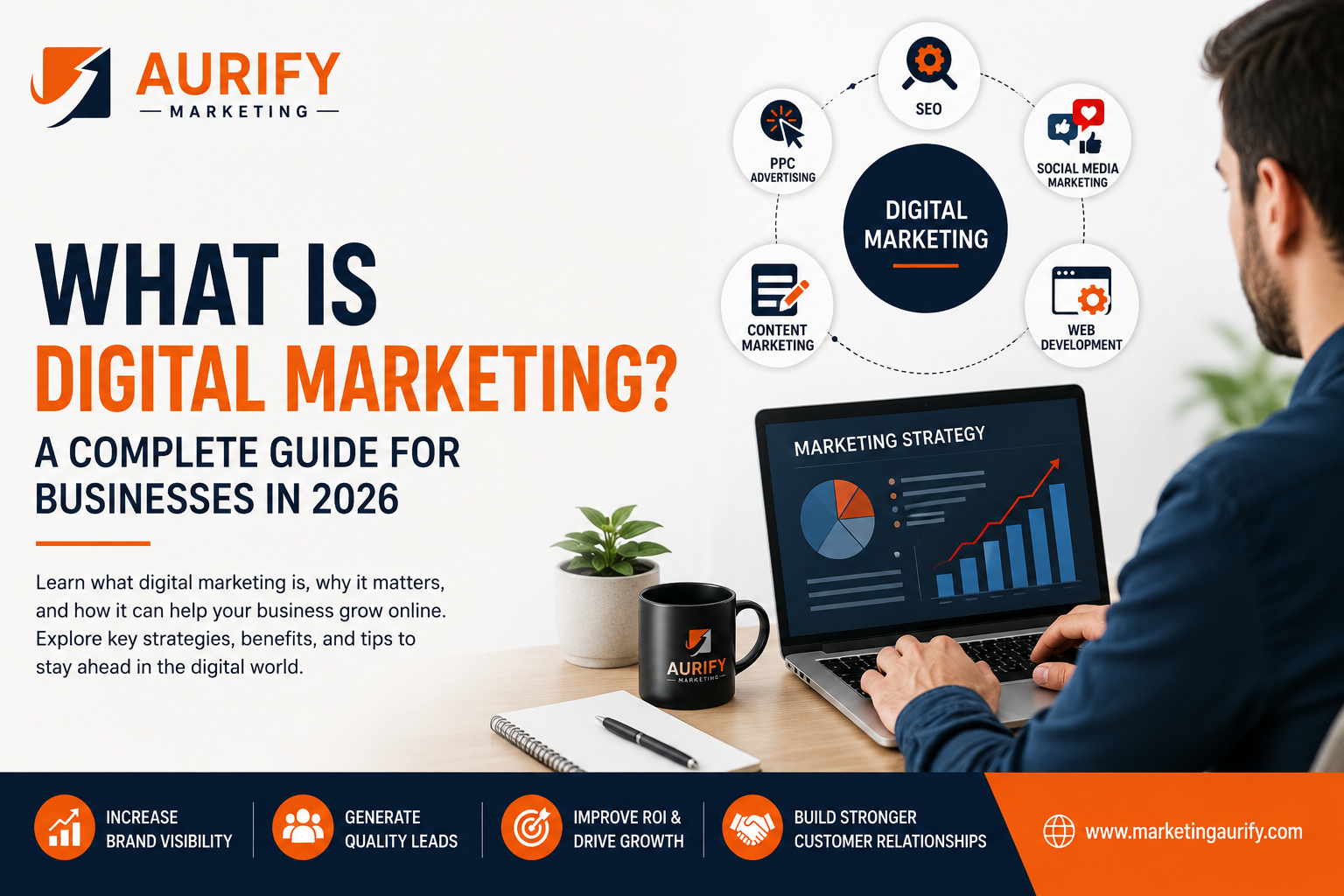
What is Digital Marketing?
Digital marketing is basically using the internet to market your goods and services. That is to say using things like search engines, social media networks, emails, websites and paid advertising. Unlike old forms of marketing using print media, television and radio, digital marketing is based on the internet and as a result it is measurable and adaptable. In practice it’s any contact that helps a consumer discover, learn, buy and do business with your business on the internet. This can be as simple as an internet search that sends a visitor to your website, a Facebook ad that exposes a new customer to your goods and then followed up by email that persuades this consumer to pay. It’s a large area that applies to sole business owners, startups to large businesses and it is essential.
Why Digital Marketing is Important for Businesses
Consider where your customers spend most of their time today online. From searching on Google to scrolling through social media, digital channels have become the primary way people discover and interact with brands.
Digital marketing lets you meet them exactly where they are. Here is why it matters so much for businesses today.
Brand Awareness at Scale: Traditional advertising is expensive and difficult to target. Digital marketing lets a small business in any city build brand recognition far beyond its immediate geography at a fraction of the cost.
Qualified Lead Generation: Rather than broadcasting to a wide audience and hoping for the best, digital marketing helps you attract people who are already interested in what you offer. When someone searches “accountant for small business in Mumbai,” they are looking for exactly that. A well-optimized website puts you in front of them at the right moment.
Cost-Effectiveness: A ₹10,000 newspaper ad might reach 50,000 people with no way to know who actually read it. The same budget on a targeted Google or Meta ad campaign reaches a defined audience, tracks every click, and tells you your exact cost per lead.
Customer Relationships That Last: Digital marketing tools from email automation to social media engagement allow businesses to stay in touch with customers long after a sale. That ongoing relationship drives repeat purchases, referrals, and long-term loyalty.
Major Types of Digital Marketing
Digital marketing is not one single thing it is a collection of channels and tactics, each serving a different purpose. Here is a clear breakdown of the most important ones:
Search Engine Optimization (SEO)
SEO is the practice of optimizing your website so it appears higher in Google’s organic (unpaid) search results when people search for topics related to your business.
Many websites fail to rank for relevant keywords, making it difficult for potential customers to find them online. According to Google’s official documentation on search optimization, businesses should focus on creating helpful and user-focused content to improve visibility https://developers.google.com/search
When someone types “best accounting software for startups” into Google, the businesses that appear on page one have invested in SEO. They’ve created high-quality content, earned links from other reputable websites, and made sure their site loads fast and works well on mobile.
One of the biggest reasons businesses invest in SEO is its long-term value. Unlike paid advertising, a well-optimized page can continue attracting traffic months or even yearsafter it’s published
For most businesses, SEO is the single highest long-term return channel in their digital marketing strategy.
“For instance, a local bakery that ranks for “best birthday cakes in Lucknow” can generate enquiries every day without paying for ads”.
Pay-Per-Click Advertising (PPC)
PPC advertising means you pay a fee each time someone clicks on your ad. Google Ads is the most common PPC platform, but it also includes Meta Ads (Facebook and Instagram), LinkedIn Ads, and YouTube advertising.
Paid advertising is another area where businesses often face challenges. Businesses can leverage platforms such as Google Ads to reach targeted audiences and improve lead generation https://ads.google.com
The defining advantage of PPC is speed. While SEO can take months to gain traction, a well-set-up Google Ads campaign can put your business at the top of search results within hours of going live.
PPC works especially well for promotions, new product launches, or businesses in competitive markets where organic rankings take time. The key to making it work is precise audience targeting, compelling ad copy, and a landing page designed to convert — otherwise you are spending money without results.
“A real estate company launching a new project can use Google Ads to start generating leads within days instead of waiting months for organic rankings”.
Social Media Marketing
Social media marketing covers both organic content (posts, stories, reels, threads) and paid advertising across platforms like Instagram, Facebook, LinkedIn, X (formerly Twitter), and TikTok.
Social media has also become a critical channel for customer engagement and brand awareness. Platforms like Facebook and Instagram continue to play a major role in digital marketing strategies https://www.facebook.com/business
For consumer-facing businesses, social media is often where brand personality lives. It is where customers discover you, judge whether they trust you, and decide to follow, share, or buy. For B2B companies, LinkedIn has become an indispensable channel for reaching decision-makers and building professional credibility.
Consistency matters more than virality here. Showing up regularly with content that genuinely helps or entertains your audience builds trust far better than one-off campaigns, For example, a local business posting useful content three times a week will often outperform a competitor that posts once a month and hopes for a viral hit.
Content Marketing
Content marketing is the strategy of creating and distributing valuable, relevant content blog articles, videos, podcasts, case studies, infographics to attract and engage your target audience.
The key word is “valuable.” Content marketing does not directly push a sale. Instead, it earns trust by answering real questions your customers have, demonstrating your expertise, and keeping your brand top-of-mind when they are ready to make a decision.
A business that consistently publishes helpful, well-written blog content does more than drive traffic it establishes itself as an authority in its field. And authority, in both Google’s eyes and your customers’, translates directly to business growth.
Email Marketing
Despite every new platform that emerges, email marketing consistently delivers one of the highest returns on investment in digital marketing often cited at around ₹3,600 return for every ₹100 spent.
Email marketing involves building a list of subscribers (people who have opted in to hear from you) and communicating with them through newsletters, promotional offers, product updates, or automated sequences triggered by their behavior.
The reason email works so well is ownership. You are not at the mercy of an algorithm. When you send an email, it lands directly in someone’s inbox no platform can reduce your reach overnight.
“An e-commerce brand can automatically send abandoned cart emails and recover sales that would otherwise be lost”
Influencer Marketing
Influencer marketing involves partnering with individuals who have built trusted audiences in specific niches — whether that is a fitness creator on Instagram, a finance commentator on YouTube, or an industry expert on LinkedIn.
The value here is borrowed trust. When an influencer whose opinion their audience genuinely respects recommends your product, it carries far more weight than a traditional advertisement. For new brands especially, the right influencer partnership can dramatically compress the time it takes to build credibility.
Benefits of Digital Marketing for Businesses
Taken together, a well-executed digital marketing strategy delivers benefits that traditional marketing simply cannot match.
Measurable results One of the key reasons digital marketing stands out from the rest is that you can actually keep tabs on almost everything – from how many people are visiting your website to whether your ads are getting any clicks at all. That’s got to help you figure out what’s working and where you’re still falling short
Precise targeting With digital marketing, you’ve got the ability to zero in on people who’ll actually care about your business – people who fit neatly into certain demographics like where they live, or what they like to do online, or what age they are. That means your marketing’s going to be seen by people who are actually a good fit for what you’re selling.
Cost-Effective Marketing
Let’s be honest – compared to the old-school ad methods, digital marketing is often a heck of a lot cheaper and way more flexible. You can start with a relatively small budget and just see how it goes – and if things start to take off, you can always start throwing more money at it.
Increased brand awareness
Getting your brand out there in front of the right people is more straightforward with digital marketing. Whether its Google search results, social media or creating content that resonates with your audience – there are loads of channels to choose from to stay top of mind for your potential customers
Better customer engagement
With digital marketing you can actually engage with customers where they are – facebook, email, forums and more. Regular two-way conversations help build trust & a long term relationship
Scalability & growth
As your business grows your marketing efforts can naturally grow with it too. Scaling campaigns, trying new channels & reaching new audiences gets a whole lot easier when you’ve got the flexibility you need – without all the logistical nightmares of trying to get too big too fast
Digital Marketing Trends in 2026
The digital marketing landscape does not stand still. Here are the trends shaping how smart businesses are growing online this year.
AI-Powered Personalization Marketing tools now use artificial intelligence to deliver personalized content, product recommendations, and ad creatives at scale. Businesses that use AI to tailor experiences are seeing significantly higher engagement and conversion rates.
GEO Optimization (Generative Engine Optimization) With Google’s AI Overviews, ChatGPT search, and Perplexity changing how people find information, optimizing content to appear in AI-generated answers has become a priority alongside traditional SEO.
Short-Form Video Dominance Instagram Reels, YouTube Shorts, and TikTok continue to be the highest-reach organic content formats across almost every industry. Brands that have not yet invested in short-form video are leaving significant visibility on the table.
Zero-Click Search Adaptation More searches than ever are being answered directly on Google’s results page without a click. Content strategies are adapting to win these featured snippets and AI answer placements.
First-Party Data Strategy With third-party cookies phasing out, businesses that have built strong email lists, CRM databases, and direct customer relationships have a clear competitive advantage in their advertising.
We’re already seeing this shift happen. Businesses that optimize content for AI-powered search experiences are gaining visibility beyond traditional Google rankings
Common Digital Marketing Mistakes to Avoid
Even businesses with good intentions often make the same avoidable errors. Watch out for these.
Trying to do everything at once. Spreading budget and effort thin across every channel rarely works. Start with one or two channels, do them well, then expand.
Ignoring mobile. Over 70% of web traffic now comes from mobile devices. A website that loads slowly or looks broken on a phone will cost you customers every single day.
Skipping analytics. If you are running campaigns but not checking your data, you have no way of knowing what is working. Google Analytics 4 and your ad platform dashboards are essential, not optional.
Publishing content with no strategy. Random blog posts or social content without a clear keyword or audience intent behind them rarely drive meaningful organic traffic. Every piece of content should have a purpose.
Expecting overnight results from SEO. SEO is a long-term investment. Businesses that abandon it after two months because they haven’t seen results are the same businesses who remain invisible on Google for years.
How Aurify Marketing Helps Businesses Grow Online
Many businesses invest time and money into marketing but struggle to connect those efforts to actual leads and revenue. That’s where a structured strategy makes a difference.
The team at Aurify Marketing works with small businesses, startups, and growing companies to build and execute digital marketing strategies that deliver measurable returns not vanity metrics.
Here is how they help:
SEO – Aurify builds long-term organic visibility through technical SEO, content strategy, and authoritative link building that compounds over time through its SEO Consultancy Services
PPC Advertising – From Google Search to Meta Ads, the team manages paid campaigns with a focus on qualified leads and a profitable return on ad spend—not just clicks—through its Brand Strategy Services.
Social Media Marketing – Aurify handles content creation, community management, and paid social campaigns that build audiences who actually convert through its Social Media Marketing Services.
Content Marketing – A dedicated content team produces SEO-driven articles, case studies, and resources that build topical authority and attract the right visitors month after month through its Content Marketing Services.
Website Designing – A well-built website is the foundation of a good online presence. Aurify designs responsive, user-friendly, and visually appealing websites that highlight your brand and provide a seamless experience across all devices. The emphasis is on creating websites that engage visitors, enhance user experience, and boost business growth Website Design & Development Services
Frequently Asked Questions
- What is the difference between digital marketing and traditional marketing? Traditional marketing uses offline channels — TV, print, radio, billboards. Digital marketing uses online channels — websites, search engines, social media, email. Digital marketing is generally more targeted, measurable, and cost-effective for most businesses.
- How much should a small business spend on digital marketing? There is no single right answer, but a common benchmark is allocating 7–12% of your revenue to marketing. For small businesses starting out, even a focused budget of ₹15,000–₹30,000 per month across SEO and one paid channel can produce meaningful results if managed well.
- How long does SEO take to show results? Most businesses begin seeing measurable ranking improvements within 3–6 months, with significant traffic growth typically visible at 6–12 months. SEO rewards consistency the longer you invest, the stronger your returns.
- Do I need to be on every social media platform? No. It is far better to show up consistently on two platforms where your audience actually spends time than to post sporadically on five. For most B2B businesses, LinkedIn and Google are the priority. For consumer brands, Instagram and YouTube often deliver the best results.
- Can I do digital marketing myself, or do I need an agency? Many small business owners successfully manage basic digital marketing themselves particularly social media and email. However, channels like SEO, Google Ads, and paid social advertising have steep learning curves, and mistakes can be costly. Working with a specialist or agency for those channels typically delivers a faster, more reliable return.
Conclusion
Digital marketing is no longer a separate department or an optional extra. For any business that wants to grow, attract new customers, and build lasting brand recognition, it is the engine that makes everything else possible.
Search engine optimization builds lasting visibility. Paid advertising puts you in front of buyers immediately. Social media and content marketing earn trust over time. Email marketing keeps customers coming back. Together, these channels form a strategy that is far greater than the sum of its parts. We’ve seen small businesses generate impressive growth simply by showing up consistently online and focusing on the channels that matter most to their audience
Whether you are just getting started or looking to get more out of your existing efforts, the best time to invest in your digital presence is now. Start with one channel, build a foundation, and grow from there.