
Search is no longer limited to Google.
A few years ago, if someone wanted to find the best SEO agency or learn how to improve their website traffic, they opened Google, typed a query, and clicked one of the top results. Today, that journey looks very different. Many users ask ChatGPT for recommendations, compare answers on Perplexity, check Google’s AI Overview, or use Gemini before they ever visit a website.
For businesses, this changes everything.
Ranking on Google’s first page is still valuable, but it’s no longer the only place where customers discover brands. If your business isn’t being mentioned by AI-powered search engines, you’re already missing opportunities that didn’t exist a few years ago.
This is where the conversation around SEO and Generative Engine Optimization (GEO) begins.
Some marketers claim SEO is dead. Others believe GEO will replace traditional optimization altogether. Neither is true.
SEO and GEO solve different problems, and in 2026 the businesses seeing the strongest organic growth are combining both strategies instead of choosing one over the other.
In this guide, you’ll learn how SEO and GEO work, why AI search is changing digital marketing, and how to build a strategy that helps your business earn visibility across Google Search, AI Overviews, ChatGPT, Gemini, Claude, and Perplexity. More importantly, you’ll understand what you should focus on today to stay competitive over the next few years.
What Is SEO?
Search Engine Optimization, commonly known as SEO, is the practice of improving a website so that it appears higher in search engine results when people look for information, products, or services.
Although the concept has been around for decades, SEO has changed significantly. Modern SEO is no longer about repeating keywords or building thousands of low-quality backlinks. Google’s algorithms have become much better at understanding user intent, content quality, website experience, and authority.
Imagine someone searches for “best SEO agency in India.” Google doesn’t simply display websites that mention those words the most. Instead, it tries to understand which pages genuinely answer the user’s question, provide useful information, load quickly, offer a good experience across devices, and demonstrate real expertise.
That’s why successful SEO today is built around helping people rather than trying to manipulate search engines.
A strong SEO strategy improves your visibility for relevant searches, attracts qualified visitors, and generates leads without relying entirely on paid advertising. Unlike ads, which stop producing results the moment your budget runs out, organic rankings can continue bringing traffic for months or even years when supported by consistent updates and high-quality content.
SEO also plays a much bigger role than simply increasing website visits. It builds trust. When users repeatedly see your brand appearing for valuable searches, they begin to recognise your expertise before they even become customers.
What Is GEO?
Generative Engine Optimization, or GEO, is one of the biggest changes in digital marketing.
Instead of helping your website rank on a traditional search results page, GEO focuses on making your content easy for AI systems to understand, trust, and reference when generating answers.
Think about how ChatGPT or Google’s AI Overview responds to a question. Rather than showing ten blue links, these systems analyse information from multiple trusted sources and create one clear response. If your content is well structured, factually accurate, and demonstrates genuine expertise, there’s a much better chance that AI will mention your brand or use your information when answering users.
This changes the way businesses think about visibility.
Success is no longer measured only by rankings and clicks. It’s also measured by how often your brand appears in AI-generated responses, how frequently your content is cited, and whether people recognise your business as a trusted source within your industry.
For agencies like Aurify Marketing, this presents a significant opportunity. Businesses that invest in both SEO and GEO today are positioning themselves to gain visibility not only on Google but also across the growing ecosystem of AI-powered search platforms.
Why Search Changed in 2026
For years, SEO was mainly about earning a position on Google’s first page. The higher your website ranked, the better your chances of getting clicks and leads. While that still matters, the way people search has changed dramatically.
Today, users expect immediate answers. Instead of opening five different websites to compare information, many simply ask ChatGPT, Gemini, Claude, or Perplexity a question and receive a complete response in seconds. Google has also embraced this shift with AI Overviews, which often answer a query before users even scroll to the traditional search results.
This doesn’t mean websites have become less important. It means they now play a different role.
Search engines and AI platforms still need reliable websites to learn from. They depend on high-quality content written by real experts. The difference is that users may discover your brand through an AI-generated answer before they ever visit your website.
That is why businesses can no longer think only about ranking. They also need to think about becoming a trusted source that AI systems are confident enough to recommend.
How Google AI Overviews Are Changing SEO
Google’s AI Overview is one of the biggest changes to search in recent years.
Instead of showing only a list of websites, Google now creates a summary using information from several trusted sources. This summary appears above the traditional organic listings for many informational searches.
Imagine someone searches:
“How can a local business improve its SEO in 2026?”
Instead of clicking three different blogs, the user may find a detailed answer directly inside Google’s AI Overview. If your website is one of the sources used to create that answer, your brand gains visibility before users even begin scrolling.
This creates a new challenge.
Ranking on page one is still valuable, but being considered trustworthy enough to contribute to AI-generated answers has become just as important.
Businesses that publish original insights, practical examples, and well-structured content have a much better chance of being referenced than websites that simply repeat what everyone else has already written.
How AI Search Engines Choose Which Content to Trust
One of the biggest misconceptions about GEO is that AI models randomly pick websites when generating answers.
They don’t.
Although every platform uses its own technology, they all look for similar quality signals. They try to understand whether a piece of content demonstrates expertise, answers the user’s question clearly, and provides information that can be trusted.
Instead of rewarding pages that simply repeat keywords, AI systems prefer content that explains a topic in depth, supports claims with evidence, and presents information in a logical structure.
Think about two articles covering the same topic.
The first article contains generic advice copied from dozens of other blogs. It offers no examples, no personal experience, and nothing new.
The second article explains the topic step by step, includes original screenshots, real client examples, practical recommendations, and answers the questions people genuinely ask.
Which one would you trust?
AI systems make a similar judgement.
They are designed to identify content that adds value rather than content created only to target search rankings.
GEO Is Built on Trust, Not Tricks
Many businesses are searching for a quick formula to rank in AI search.
There isn’t one.
Just as Google evolved beyond keyword stuffing years ago, AI search rewards quality over shortcuts.
Content that performs well usually shares a few characteristics.
It answers one topic thoroughly instead of covering dozens of unrelated subjects. It includes clear headings, simple language, real-world examples, and logical explanations. Most importantly, it reflects genuine expertise rather than rewritten summaries from competing websites.
This is why experience matters more than ever.
If you’ve completed an SEO campaign that increased traffic by 200%, talk about the process. If you’ve solved a technical SEO issue for an ecommerce business, explain what happened and what you learned.
Original knowledge is difficult to copy, and that’s exactly what makes it valuable for both search engines and AI platforms.
Should Businesses Replace SEO with GEO?
No.
This is one of the biggest myths in digital marketing today.
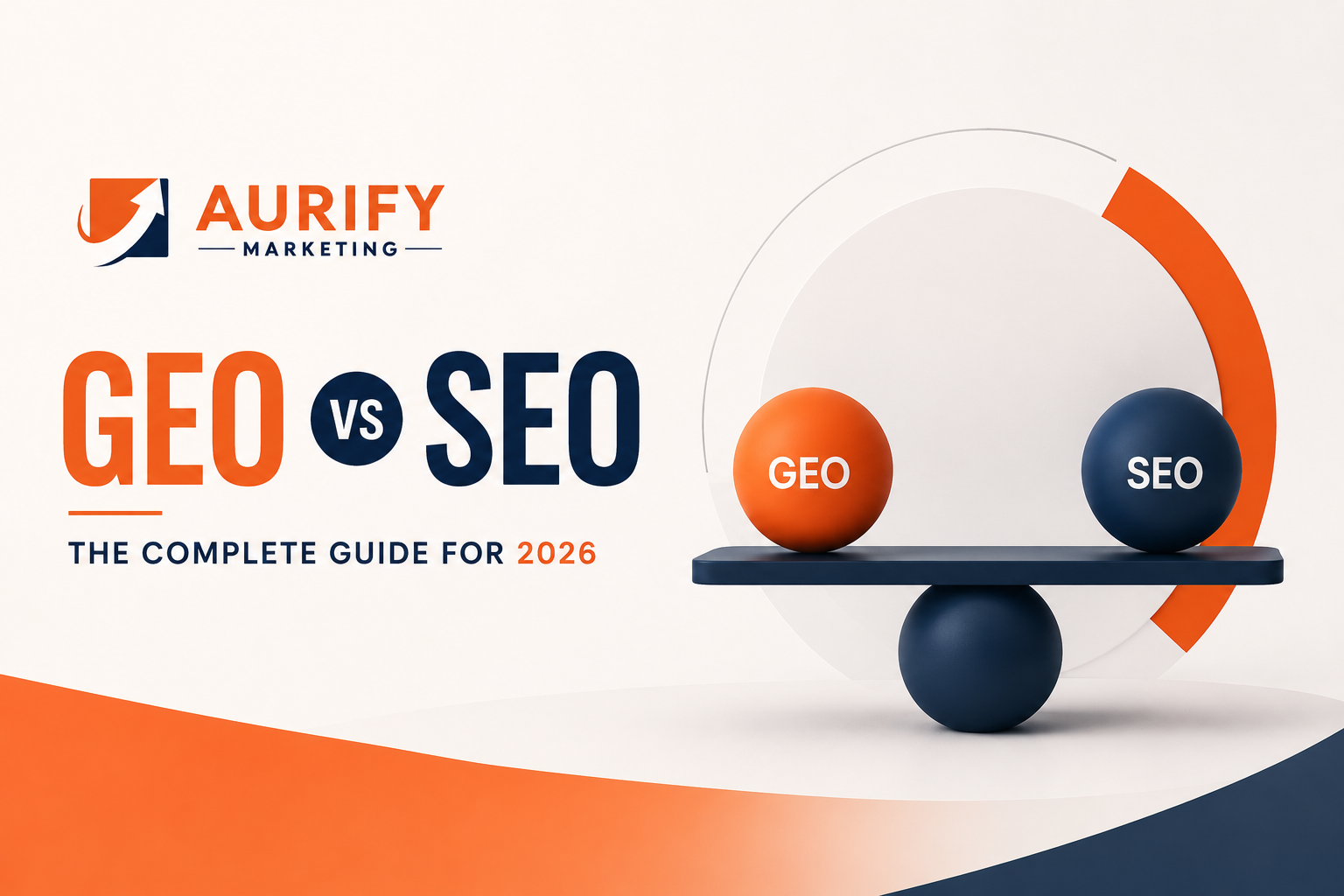
SEO and GEO are not competitors. They are complementary strategies.
SEO helps your website appear when people search on Google and Bing. GEO helps your expertise become visible when people ask AI-powered search engines for answers.
Ignoring SEO means missing valuable organic traffic.
Ignoring GEO means missing a growing audience that prefers conversational search over traditional search results.
The smartest businesses don’t choose one over the other.
They create content that works for both.
A well-written article should be capable of ranking on Google while also being structured in a way that allows AI systems to understand, summarise, and reference it confidently.
That is exactly where the future of organic marketing is heading.
SEO vs GEO: Which One Delivers Better Results?
The answer depends on what success means for your business.
If your primary goal is to increase website traffic, traditional SEO remains the strongest long-term investment. Ranking for commercial keywords can generate consistent leads without relying on paid advertising.
However, if your goal is to increase brand awareness and become recognised as an industry expert, GEO offers an entirely new opportunity.
When AI assistants recommend your business as a trusted source, users often develop confidence in your brand before they even visit your website.
The businesses seeing the best results in 2026 are not choosing between traffic and authority.
They are building both at the same time.
SEO attracts visitors.
GEO builds recognition.
Together, they create a stronger organic presence than either strategy can achieve on its own.
Why This Matters for Growing Businesses
Whether you’re a startup, a local service provider, or an established company, the way customers discover businesses is changing.
People no longer rely on one platform. A customer might first ask ChatGPT for recommendations, compare agencies on Google, read reviews, visit your website, and finally contact you through your Google Business Profile.
Every one of those touchpoints influences their decision.
Businesses that appear consistently across search engines and AI platforms naturally build more credibility than those visible in only one place.
This is why forward-thinking agencies like Aurify Marketing focus on creating content that serves both humans and AI systems. Instead of chasing algorithm updates or relying on outdated SEO tactics, the goal is to build genuine topical authority, publish original insights, and create resources that remain useful long after they’re published.
How to Build an SEO & GEO Strategy That Works in 2026
The biggest mistake businesses make is treating SEO and GEO as two separate marketing strategies. In reality, they work best together.
Traditional SEO helps search engines understand your website and rank it for relevant keywords. GEO helps AI platforms understand your expertise and trust your content enough to reference it in their answers.
Instead of creating one version of content for Google and another for AI, focus on producing content that genuinely solves a problem. If your article answers a question better than your competitors, explains the topic clearly, and provides original insights, it has a much higher chance of performing well in both search environments.
A modern content strategy should begin with understanding what your audience wants to know. Rather than targeting a single keyword, build content around an entire topic. For example, if your service is SEO, don’t stop at writing one article about SEO. Cover technical SEO, local SEO, ecommerce SEO, AI SEO, Core Web Vitals, keyword research, link building, schema markup, SEO audits, Google Business Profile optimization, and SEO case studies. This creates topical authority, making it easier for both Google and AI models to recognise your website as a trusted source.
What Makes Content AI-Friendly?
There’s a common belief that GEO requires a completely different writing style.
It doesn’t.
The qualities that make content useful for people are often the same qualities that help AI understand and reference it.
Start by answering the main question early in the article instead of making readers scroll through unnecessary introductions. Use clear headings that explain exactly what each section covers. Keep your language simple, avoid jargon where possible, and explain technical concepts with examples.
Originality is another major factor.
If your article says the same thing as every other blog on the internet, there’s little reason for AI systems to prioritise it. On the other hand, if you include your own experiences, original research, client case studies, screenshots, or practical frameworks, your content becomes far more valuable.
For example, instead of writing:
“Backlinks are important for SEO.”
Explain why they matter, share how you earned high-quality backlinks for a client, what worked, what failed, and the results you achieved.
That level of detail builds trust because it demonstrates real experience rather than theoretical knowledge.
Focus on Topics, Not Just Keywords
For years, SEO campaigns revolved around finding one keyword and creating one page.
That approach is becoming less effective.
Today, search engines and AI models are better at understanding relationships between topics. They don’t just analyse individual pages; they evaluate how well your entire website covers a subject.
Imagine two agencies.
The first has five random SEO blogs published over the last year.
The second has a complete resource hub covering technical SEO, AI SEO, local SEO, ecommerce SEO, SEO audits, Core Web Vitals, keyword research, schema markup, and real case studies.
Which agency appears more authoritative?
The answer is obvious.
Topical authority isn’t built overnight, but it creates long-term competitive advantages that are difficult for competitors to copy.
Build Content That Demonstrates Experience
Google’s EEAT guidelines have become increasingly important, and the same principle applies to AI search.
People trust experts who have actually done the work.
If you’ve managed SEO campaigns for local businesses, share the process. If you’ve improved Core Web Vitals for an ecommerce store, explain what changed and how it affected performance. If you’ve helped a startup grow through organic search, publish the results with real screenshots and measurable outcomes.
These examples do more than improve credibility.
They help readers understand that your advice comes from experience, not assumptions.
For a digital marketing agency, case studies are often more persuasive than generic blog posts because they show real business impact.
Don’t Ignore Technical SEO
Even the best content struggles if search engines can’t crawl, understand, or index it properly.
Technical SEO remains the foundation of every successful organic strategy.
Your website should load quickly, work well on mobile devices, use clean URLs, include structured data where appropriate, and maintain a logical internal linking structure.
Broken pages, duplicate content, poor navigation, or slow loading times create unnecessary barriers for both users and search engines.
Think of technical SEO as building a strong foundation for a house.
Without it, everything else becomes less effective.
Why Brand Authority Matters More Than Ever
Search algorithms continue to evolve, but one factor is becoming increasingly clear.
Strong brands perform better.
When your business is mentioned across reputable websites, featured in industry publications, discussed on social media, and recognised within your niche, both search engines and AI systems gain stronger confidence in your authority.
Brand building isn’t separate from SEO anymore.
It has become part of SEO.
Publishing original research, appearing on podcasts, contributing guest articles, speaking at industry events, and earning mentions from trusted publications all strengthen your online presence.
Over time, these signals work together to increase both search visibility and AI recognition.
How Aurify Marketing Helps Businesses Stay Ahead
Search is evolving quickly, and many businesses are still relying on strategies that worked five years ago.
At Aurify Marketing, we believe modern SEO is about much more than rankings.
Our approach combines technical SEO, high-quality content, topical authority, digital PR, and Generative Engine Optimization to help businesses grow across both traditional search engines and AI-powered platforms.
Rather than chasing shortcuts or temporary ranking tactics, we focus on building sustainable organic growth. Every strategy is tailored to the business, industry, competition, and customer journey because no two websites have the same challenges.
Whether you’re a startup looking to build your online presence or an established business aiming to increase qualified leads, the goal remains the same: create content that people trust and search platforms want to recommend.
As AI continues to reshape search, businesses that invest in quality today will be far better positioned for tomorrow.
The Future of Search Isn’t SEO or GEO. It’s Both.
The debate between SEO and GEO misses the bigger picture.
Search isn’t being replaced.
It’s expanding.
Google still processes billions of searches every day, while AI assistants are changing how people discover information. Instead of competing with each other, these platforms now work alongside one another, giving businesses more opportunities to reach potential customers.
The companies that succeed in 2026 won’t be the ones chasing every algorithm update. They’ll be the ones consistently publishing helpful content, sharing real expertise, solving genuine problems, and building trust over time.
That’s exactly what SEO has always been about.
GEO simply extends that philosophy into the world of AI.
If your business wants sustainable organic growth, don’t optimise only for rankings. Optimise to become the brand that both people and AI trust.
When you achieve that, higher rankings, stronger visibility, and better leads become a natural result—not the goal itself.
Frequently Asked Questions
Is GEO replacing SEO?
No. GEO complements SEO rather than replacing it. SEO helps your website rank in traditional search engines, while GEO increases your visibility across AI-powered search platforms such as ChatGPT, Gemini, Perplexity, Claude, and Google AI Overviews.
Can a business succeed with SEO alone?
Yes, but relying only on traditional SEO means missing opportunities in AI-driven search. A combined SEO and GEO strategy provides broader visibility and prepares your business for the future of search.
Does Google AI Overview affect website traffic?
It can. Some informational searches receive answers directly within AI Overviews, which may reduce clicks. However, websites that become trusted sources for AI Overviews often gain greater brand exposure and attract more qualified visitors.
What is the biggest ranking factor for GEO?
There isn’t a single ranking factor. High-quality content, topical authority, real expertise, clear structure, original insights, trustworthy sources, and strong brand reputation all contribute to better AI visibility.
How long does it take to see results from SEO and GEO?
SEO typically takes three to six months to show meaningful improvements, depending on competition and website authority. GEO is still evolving, but businesses that consistently publish expert-led, high-quality content are already seeing increased visibility in AI-generated responses.
Final Thoughts
The future of organic marketing belongs to businesses that create the best answers, not just the most content.
Whether someone searches on Google, asks ChatGPT a question, reads an AI Overview, or uses Gemini to compare services, they are all looking for the same thing: information they can trust.
That is why the most successful SEO strategy in 2026 is no longer just about ranking higher. It is about becoming the brand that deserves to be found.
If your business focuses on expertise, helpful content, technical excellence, and consistent authority building, you’ll be well positioned to grow across both traditional search and the next generation of AI-powered discovery.
And that’s exactly where the future of digital marketing is headed.