

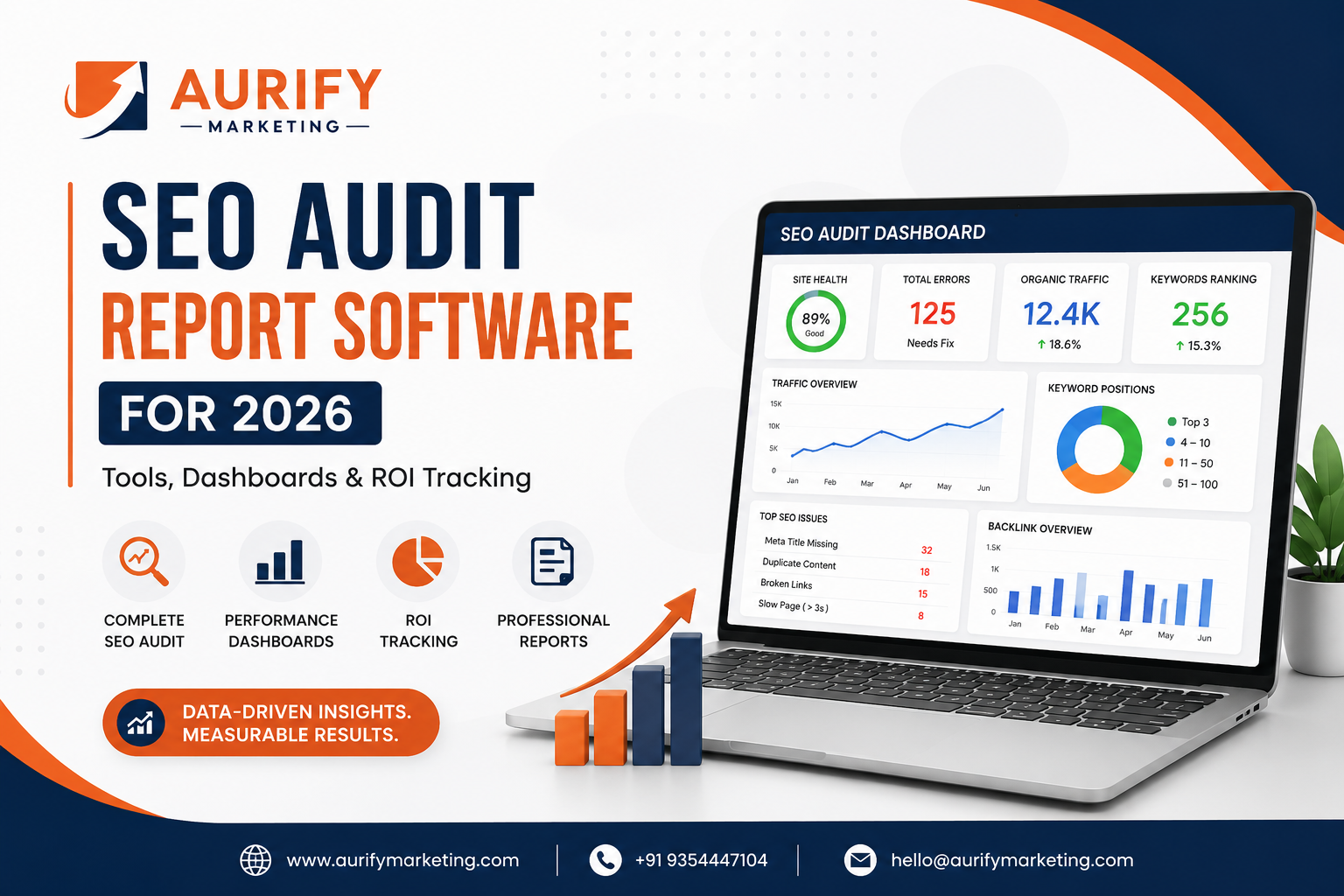
Professional SEO audit dashboard banner showcasing tools, performance metrics, and ROI tracking, branded with Aurify Marketing and contact details.
Search engine optimization is no longer just about rankings. In 2026, it’s about clarity, performance, and measurable growth. Businesses don’t just want traffic — they want results they can track and scale. That’s where SEO audit report software comes in.
If you’re running an agency like Aurify Marketing or managing your own website, you already know that guessing doesn’t work anymore. You need data. You need insights. And most importantly, you need tools that turn complex SEO data into simple, actionable reports.
This guide breaks down the best SEO audit tools, how to build powerful dashboards, and how to track real ROI from your SEO efforts.
Why SEO Audit Software Matters in 2026
SEO has evolved fast. Google’s algorithms are smarter, competition is tougher, and user expectations are higher. A basic audit is no longer enough.
Modern SEO audit software helps you:
Identify technical issues quickly
Analyze on-page and off-page SEO
Track keyword performance
Monitor backlinks and site health
Generate professional reports for clients
Measure ROI with real data
Without these tools, you’re working blind. And in today’s market, that’s a risk you can’t afford.
What Makes a Great SEO Audit Tool
Not all tools are built the same. Some focus only on technical audits, while others give you a complete picture of your website performance.
A strong SEO audit software should include:
Full website crawl and error detection
Keyword tracking and ranking insights
Backlink analysis
Competitor comparison
Automated reporting
Custom dashboard for performance tracking
The goal is simple — save time while improving accuracy.
Best SEO Audit Report Software for 2026
Let’s look at some of the most reliable tools that agencies and businesses are using right now.
1. SEMrush
SEMrush continues to dominate the SEO space. It offers a complete toolkit including site audits, keyword research, competitor analysis, and backlink tracking.
What makes it stand out is its reporting system. You can generate detailed audit reports and even customize them for clients.
Best for: Agencies and advanced SEO professionals
2. Ahrefs
Ahrefs is known for its powerful backlink database and site explorer features. Its audit tool scans your website and highlights technical issues that affect performance.
The interface is simple, but the data is deep. Perfect for those who want accuracy without complexity.
Best for: Link building and competitor research
3. Screaming Frog
This is a desktop-based tool that’s widely used for technical SEO audits. It crawls your website and identifies issues like broken links, duplicate content, and missing tags.
It’s not flashy, but it’s incredibly effective.
Best for: Technical SEO audits
4. Google Search Console
A free tool that every website owner should use. It provides insights directly from Google, including indexing issues, keyword performance, and site health.
While it doesn’t replace paid tools, it complements them perfectly.
Best for: Monitoring real search performance
5. Ubersuggest
A budget-friendly tool that offers keyword research, SEO audits, and content ideas. It’s great for beginners or small businesses.
Best for: Entry-level SEO and startups
Building an SEO Report Dashboard
Data is only useful if you can understand it. That’s why dashboards are essential.
An SEO dashboard gives you a visual overview of your performance. Instead of digging through spreadsheets, you can see everything in one place.
Key Metrics to Include
Organic traffic growth
Keyword rankings
Bounce rate and engagement
Backlink profile
Conversion rate
Page performance
Tools like Google Data Studio or built-in dashboards from SEO platforms help you create clean and professional reports.
For agencies like Aurify Marketing, dashboards are not just internal tools — they are client communication assets.
How to Track SEO ROI
One of the biggest challenges in SEO is proving its value. Rankings are great, but clients care about revenue.
Tracking ROI means connecting SEO efforts to business results.
Step 1: Set Clear Goals
Define what success looks like. It could be:
More leads
More sales
Increased traffic
Higher conversions
Step 2: Track Conversions
Use analytics tools to measure how users interact with your site. Track form submissions, purchases, or calls.
Step 3: Assign Value
Each conversion should have a value. For example, if one lead is worth ₹2000, you can calculate total revenue generated from SEO.
Step 4: Compare Cost vs Return
ROI Formula:
ROI = (Revenue from SEO – Cost of SEO) / Cost of SEO
This gives you a clear picture of performance.
Common SEO Audit Mistakes to Avoid
Even with the best tools, mistakes can happen.
Ignoring Technical Issues
Broken links, slow speed, and indexing errors can hurt your rankings.
Focusing Only on Keywords
SEO is more than keywords. User experience matters just as much.
Not Updating Reports
SEO is ongoing. Reports should be updated regularly.
Overloading Clients with Data
Keep reports simple and focused. Too much data creates confusion.
How Aurify Marketing Uses SEO Audit Tools
At Aurify Marketing, the focus is not just on audits — it’s on results.
The process includes:
Deep website analysis using advanced tools
Custom SEO reports tailored to each client
Clear dashboards for performance tracking
ROI-focused strategy implementation
This approach ensures that every SEO effort is measurable and aligned with business goals.
Future of SEO Audit Software
SEO tools are becoming smarter with automation and AI integration. But the real value still comes from human understanding.
In the future, we can expect:
More automation in reporting
Predictive SEO insights
Real-time performance tracking
Better integration with marketing platforms
The tools will evolve, but strategy will always matter.
Conclusion
SEO audit report software is no longer optional. It’s a necessity for anyone serious about growth.
The right tools help you understand your website, fix issues, and track performance. But tools alone are not enough. You need a clear strategy, consistent effort, and a focus on results.
If you want to stay ahead in 2026, invest in the right software, build strong dashboards, and always track your ROI.