

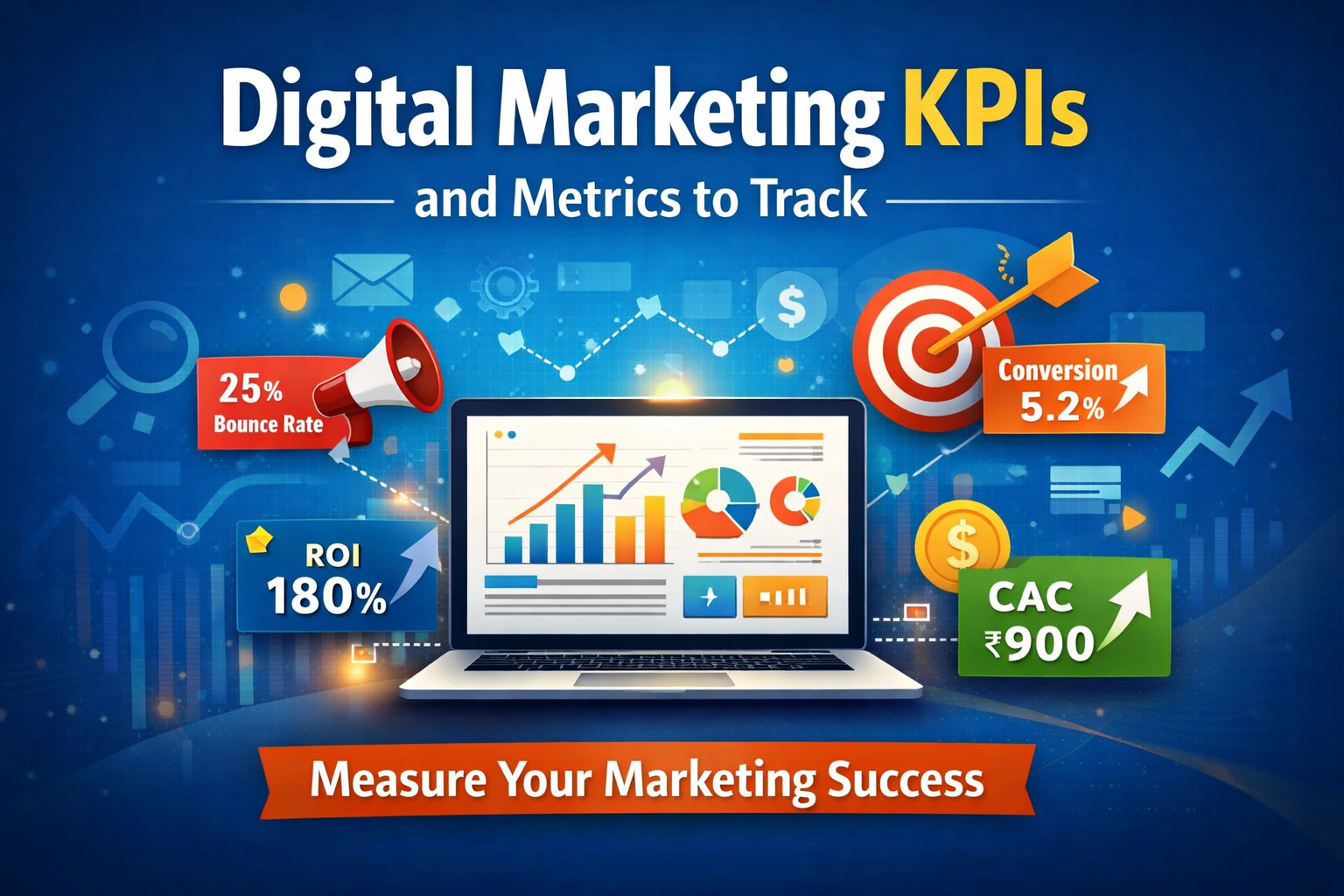
In today’s digital-first world, marketing success is no longer based on assumptions or guesswork. Every click, impression, and conversion can be tracked, measured, and optimized. However, many businesses still run campaigns without properly analyzing their performance, leading to wasted budgets and missed opportunities.
This is where Digital Marketing KPIs (Key Performance Indicators) become essential. They help you understand what’s working, what needs improvement, and how to scale your efforts efficiently.
At Aurify Marketing, we believe that data-driven strategies are the foundation of sustainable business growth. By tracking the right metrics, businesses can make smarter decisions, improve campaign performance, and maximize return on investment.
In this blog, we will explore the most important digital marketing KPIs and metrics you should track to grow your business effectively.
Why Tracking Digital Marketing KPIs Is Important
The digital landscape is highly competitive. Businesses that rely only on creativity without analyzing data often struggle to scale. Tracking KPIs provides clarity and helps eliminate guesswork from your marketing strategy.
Here’s why KPI tracking is crucial:
1. Data-Driven Decision Making
Instead of making assumptions, KPIs give you real insights into your campaign performance. You can clearly see which strategies are delivering results.
2. Better Budget Utilization
Marketing budgets are limited. Tracking KPIs ensures that every rupee is spent on strategies that generate maximum returns.
3. Performance Optimization
When you monitor metrics regularly, you can quickly identify underperforming campaigns and optimize them.
4. Competitive Advantage
Businesses that leverage data grow faster than those that don’t. KPI tracking helps you stay ahead of competitors.
At Aurify Marketing, we use advanced analytics tools to help businesses track and optimize their marketing performance effectively.
What Are Digital Marketing KPIs?
Digital marketing KPIs are measurable values that indicate how effectively your marketing campaigns are achieving business goals.
These KPIs go beyond vanity metrics like likes or followers. Instead, they focus on real outcomes such as:
- Website traffic quality
- Lead generation
- Customer acquisition
- Revenue growth
For example, getting 10,000 website visitors is great—but if none of them convert into customers, the traffic has little value. That’s why focusing on the right KPIs is critical.
Key Digital Marketing KPIs to Track
There are hundreds of metrics available, but not all of them are important. The key is to focus on the metrics that directly impact your business growth.
1. Website Traffic and Engagement Metrics
Your website is the center of your digital marketing efforts. These metrics help you understand how users interact with your site.
Important metrics include:
- Users and Sessions:
These metrics show how many people visit your website and how often. A steady increase indicates successful marketing efforts. - Bounce Rate:
This is the percentage of users who leave your website without interacting. A high bounce rate may indicate poor content, slow loading speed, or irrelevant targeting. - Average Session Duration:
This shows how long users stay on your site. Longer durations usually indicate engaging and valuable content. - Pages per Session:
This metric shows how many pages a user visits in one session. Higher numbers indicate better user experience and navigation.
👉 At Aurify Marketing, we perform detailed website audits to improve user engagement and reduce bounce rates.
2. Conversion Rate and Sales Metrics
Driving traffic is only half the job. The real success lies in converting visitors into customers.
Key conversion metrics include:
- Conversion Rate:
The percentage of visitors who complete a desired action, such as filling out a form or making a purchase. - Lead Conversion Rate:
The percentage of visitors who become leads. - Sales Conversion Rate:
The percentage of visitors who turn into paying customers. - Cost Per Conversion:
The amount you spend to acquire one conversion.
Improving conversion rates requires optimizing landing pages, improving CTAs, and ensuring your messaging aligns with user intent.
3. Customer Acquisition Cost (CAC)
Customer Acquisition Cost is one of the most important financial KPIs in digital marketing.
CAC=Total Marketing and Sales CostNumber of New CustomersCAC = \frac{\text{Total Marketing and Sales Cost}}{\text{Number of New Customers}}CAC=Number of New CustomersTotal Marketing and Sales Cost
This metric tells you how much you spend to acquire a single customer.
Example:
If you spend ₹1,00,000 and acquire 100 customers, your CAC is ₹1,000.
👉 At Aurify Marketing, we focus on reducing CAC while maintaining lead quality to ensure long-term profitability.
4. Return on Investment (ROI)
ROI is the ultimate metric that determines whether your marketing efforts are profitable.
ROI=(Net ProfitTotal Marketing Cost)×100ROI = \left(\frac{\text{Net Profit}}{\text{Total Marketing Cost}}\right) \times 100ROI=(Total Marketing CostNet Profit)×100
A positive ROI means your campaigns are generating profit, while a negative ROI indicates losses.
Tracking ROI at both overall and channel levels (SEO, PPC, social media, email) helps you allocate budgets more effectively.
5. Social Media Performance Metrics
Social media is a powerful channel for brand awareness and engagement.
Key metrics to track:
- Engagement Rate (likes, comments, shares)
- Reach and Impressions
- Click-Through Rate (CTR)
- Follower Growth Rate
High engagement indicates that your content resonates with your audience.
👉 At Aurify Marketing, we create data-driven social media strategies that focus on engagement and conversions rather than just vanity metrics.
6. Email Marketing KPIs
Email marketing remains one of the most cost-effective channels in digital marketing.
Important email metrics include:
Open Rate:
Percentage of recipients who open your email.
Click-Through Rate (CTR):
Percentage of users who click on links inside the email.
Unsubscribe Rate:
Percentage of users who opt out of your email list.
Bounce Rate:
Percentage of emails that were not delivered.
Improving these metrics requires strong subject lines, personalization, and valuable content.
How KPIs Impact Marketing Strategy
Tracking KPIs is not just about collecting data—it’s about using that data to improve your strategy.
1. Identifying Strengths and Weaknesses
KPIs help you understand what is working and what isn’t. For example, high traffic but low conversions indicate issues with your landing page.
2. Smarter Budget Allocation
You can invest more in high-performing channels and reduce spending on underperforming ones.
3. Better Forecasting
By analyzing past data, you can predict future performance and set realistic goals.
4. Increased Agility
Real-time tracking allows you to quickly adjust your campaigns based on performance.
At Aurify Marketing, we help businesses turn data into actionable insights that drive consistent growth.
How to Start Tracking Digital Marketing KPIs
If you are new to KPI tracking, follow these steps:
Step 1: Define Your Goals
Decide what you want to achieve—traffic, leads, or sales.
Step 2: Choose Relevant KPIs
Select metrics that align with your business goals.
Step 3: Use Analytics Tools
Some essential tools include:
Google Analytics
Google Search Console
Meta Ads Manager
SEMrush
Step 4: Monitor Regularly
Track your KPIs weekly or monthly.
Step 5: Optimize Continuously
Use insights to improve your campaigns.
Why Choose Aurify Marketing for KPI-Driven Growth
At Aurify Marketing, we don’t just run campaigns—we build strategies backed by data.
Our approach includes:
Advanced KPI tracking and reportingROI-focused marketing strategies
Conversion rate optimization
Performance-driven SEO and paid campaigns
We ensure that every marketing effort contributes to measurable business growth.
Conclusion
In digital marketing, success comes from understanding your data. Without tracking KPIs, you are essentially making blind decisions.
By focusing on the right metrics such as traffic, conversions, CAC, and ROI, you can:
- Improve campaign performance
- Reduce marketing costs
- Increase revenue
Start tracking your KPIs today and transform your marketing into a powerful growth engine.
If you want expert help in tracking and optimizing your digital marketing performance, Aurify Marketing is here to help you achieve your goals.