
Organic search can be one of the strongest long-term growth channels for a business, but scaling it becomes difficult when the number of potential search opportunities starts growing.
A company with multiple services, products, locations, industries, or customer segments may have thousands of relevant searches it could potentially target. Creating a dedicated SEO strategy for every opportunity manually takes significant time and resources. This is where AI and programmatic SEO can work together to create a more scalable approach to organic growth.
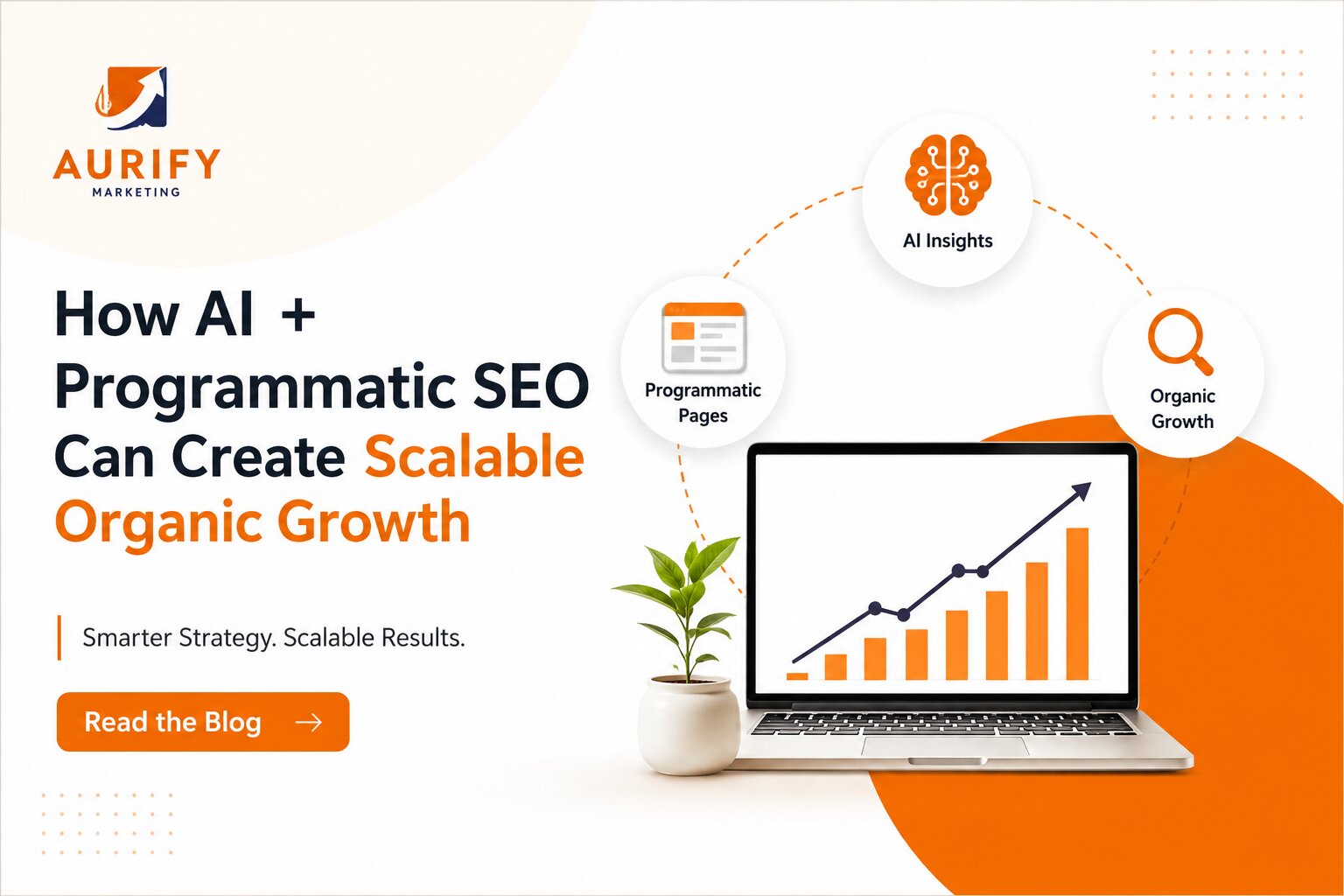
Programmatic SEO provides the framework for creating and managing large numbers of relevant pages. AI can support the research, analysis, keyword clustering, content planning, and data processing involved in that process.
But there is an important difference between using technology to scale SEO and simply publishing more pages.
The goal is not to create thousands of URLs.
The goal is to identify the right search opportunities, create genuinely useful pages around them, and build a system that can grow without compromising quality.
When AI, programmatic SEO, and a strong SEO strategy work together, businesses can expand their organic search presence while focusing on the pages that have the potential to attract qualified traffic and generate real business results.
What Is Programmatic SEO?
Programmatic SEO is an approach to search engine optimisation where pages are created using a structured system based on data, templates, and predefined page elements.
Instead of manually creating every page from scratch, a business identifies a repeatable search pattern and builds a framework that can support multiple relevant pages.
For example, imagine a company that provides 100 different services across 500 locations. In theory, that creates up to 50,000 possible service and location combinations.
A traditional SEO workflow would require the team to research, plan, write, optimise, publish, and internally link each page individually. At that scale, the process becomes difficult to manage.
A programmatic approach can help organise those opportunities into a structured system.
A web design company, for example, may have opportunities around combinations such as web design services in Delhi, web design services in Gurgaon, and web design services in Noida. An e-commerce business may have opportunities around different product categories, brands, or product types. A SaaS company may have opportunities based on industries, use cases, integrations, or customer segments.
The important point is that not every possible combination deserves a page.
A successful programmatic SEO strategy starts by identifying combinations that have genuine search demand, clear search intent, business value, and enough unique information to provide a useful experience.
The technology helps create the system.
The SEO strategy determines what belongs in that system.
Why Programmatic SEO Has Become More Relevant
Search behaviour has become increasingly specific.
Someone looking for digital marketing services may search for a broad term such as “digital marketing agency.” Another potential customer may search for “e-commerce SEO agency in Delhi” because they already know the type of service they need, the industry they operate in, and the location they want to target.
These specific searches can often indicate stronger commercial intent.
For businesses operating across multiple locations or serving different industries, this creates a large number of potential bottom-of-the-funnel search opportunities.
The challenge is finding the opportunities that actually matter.
This is where AI can make the process more efficient.
Instead of manually analysing thousands of keywords and search queries, SEO teams can use AI-assisted workflows to process large datasets, identify patterns, group similar searches, and uncover relationships between services, locations, industries, and customer needs.
However, AI does not replace the need for SEO judgement.
It can help a team analyse more information in less time, but someone still needs to determine whether a keyword represents a valuable opportunity and whether a dedicated page would genuinely improve the user’s experience.
How AI Supports Programmatic SEO
One of the biggest advantages of AI in programmatic SEO is its ability to help SEO teams work with large volumes of data.
Keyword research is a good example.
A business may have thousands of keywords related to its services, products, and target markets. Some keywords may represent the same search intent, while others may indicate completely different needs.
AI can help identify patterns within this data and group related queries.
Consider a business targeting the SEO market in Delhi. It may find searches such as “SEO agency Delhi,” “SEO company Delhi,” and “SEO services Delhi.” These queries may have overlapping intent and could potentially be addressed through a single strong page.
At the same time, “e-commerce SEO agency Delhi” may represent a more specific commercial intent that deserves a dedicated page if the business has relevant expertise and information to support it.
This distinction matters.
Creating a separate page for every keyword variation can lead to unnecessary duplication and keyword cannibalisation. A better strategy is to understand the intent behind the search and create pages that serve distinct user needs.
AI can make this analysis faster.
The final decision should still come from an experienced SEO strategy.
Search Intent Should Come Before Page Creation
The biggest mistake in programmatic SEO is starting with the number of pages rather than the value of the search opportunity.
Search volume alone does not determine whether a page should exist.
A keyword with thousands of monthly searches may bring traffic but generate very few leads. Another keyword with significantly lower search volume may come from users who are actively looking for a service and are ready to contact a provider.
For a business focused on revenue, the second opportunity may be far more valuable.
This is why search intent needs to be considered before creating programmatic pages.
A person searching “what is SEO” is likely looking for information. Someone searching “best SEO agency for SaaS companies” is researching potential providers. A user searching “hire SaaS SEO agency” is much closer to making a decision.
These searches belong to different stages of the buying journey.
For a BOFU-focused programmatic SEO strategy, the priority should be identifying search opportunities where the user has a clear commercial need and the business can offer a relevant solution.
The objective is not to maximise the number of pages.
It is to maximise the number of meaningful opportunities that can connect search demand with business value.
Scaling Content Without Creating Thin Pages
Programmatic SEO becomes risky when businesses confuse scale with quality.
A common approach is to create a template, change the location or keyword, and publish thousands of pages that are almost identical.
For example, a business may create a page for every city in a country but provide the same content on every page, changing only the city name.
From a user’s perspective, there is little reason to visit one page instead of another.
This is where programmatic SEO can become counterproductive.
Google’s current guidance on scaled content abuse focuses on the creation of large amounts of content primarily to manipulate search rankings, regardless of whether that content is produced by humans, AI, or a combination of both. The issue is not the use of automation itself. The problem is creating content at scale without providing meaningful value to users. Google Search Essentials: Spam Policies
This means businesses need to approach programmatic SEO differently.
A page targeting “SEO agency in Gurgaon” should offer genuine information relevant to businesses looking for SEO services in Gurgaon.
A page targeting “e-commerce SEO agency in Delhi” should address the specific challenges faced by e-commerce businesses and explain why the service is relevant to them.
The template can remain consistent.
The value should be specific.
That distinction is what separates scalable SEO from mass-produced content.
The Role of Unique Data in Programmatic SEO
The strongest programmatic SEO strategies usually have one thing in common: they are built around data that can support genuinely useful pages.
This data may come from a company’s product catalogue, service database, location information, pricing, availability, customer research, original studies, or industry knowledge.
For example, an e-commerce website may have thousands of products with different attributes, specifications, prices, and availability. A travel company may have destinations, hotels, activities, and travel routes. A B2B company may offer different solutions for different industries.
When this data is structured correctly, it can support pages that provide information users actually need.
This is where programmatic SEO becomes more than an SEO publishing tactic.
The website becomes a useful information system that connects users with relevant products, services, or solutions.
AI can help process and organise that information, but the underlying data is what gives the pages substance.
Without meaningful data, automation simply produces more generic content.
AI Can Help Build Better Content Systems
AI can also support the planning and management of programmatic content.
Once a business has identified the pages it wants to create, AI can assist with analysing existing content, identifying potential duplication, generating initial content briefs, finding content gaps, and reviewing large numbers of pages for consistency.
This can be particularly useful for large websites where manually reviewing every page would be difficult.
However, AI-generated content should not be treated as a finished product simply because it is grammatically correct or reads naturally.
The content still needs to be checked for accuracy, relevance, originality, and usefulness.
Google’s guidance on generative AI makes a similar distinction. Using AI to assist with content creation is not automatically against its policies, but content created primarily to manipulate rankings can violate Google’s spam policies. The focus remains on creating helpful content for people. Google Search: Guidance about using generative AI content on your website
For businesses, this means AI should be treated as part of the SEO workflow rather than a replacement for the workflow.
The strategy still needs to come first.
Programmatic SEO and Internal Linking
Scaling a website also creates another challenge: information architecture.
When hundreds or thousands of pages are added, users and search engines need a clear way to understand how those pages relate to one another.
A programmatic SEO strategy can help create a logical internal linking structure.
For example, a digital marketing agency may organise its website around services, industries, and locations. A visitor looking at an SEO service page may be able to explore related industry pages, while someone viewing an industry page can discover relevant services.
This creates a connected website structure rather than a collection of isolated landing pages.
AI can help analyse large websites and identify possible internal linking opportunities, pages that may be difficult to discover, and relationships between related topics.
But internal linking should always support a logical user journey.
Adding links simply because a system can generate them does not necessarily improve SEO.
The purpose of internal linking is to help users discover relevant information while making the site’s structure easier for search engines to understand.
A Practical Example of AI + Programmatic SEO
Imagine a digital marketing agency offering SEO, PPC, web design, social media marketing, and content marketing across several major Indian cities.
The agency may identify commercial search opportunities around specific services and locations.
Instead of creating one generic digital marketing page, the business could develop dedicated pages for high-value combinations such as SEO services in Delhi, SEO services in Gurgaon, e-commerce SEO services in Delhi, web design services in Gurgaon, and PPC services in Noida.
However, these pages should only be created when the business can provide enough relevant information to make each one useful.
A strong page targeting “SEO Services in Gurgaon” could explain the agency’s SEO process, the types of businesses it works with, relevant experience, examples of results, and the specific problems it can solve.
It could also provide a clear next step for the visitor, such as requesting an SEO consultation or discussing their website.
That page is not valuable simply because it contains the keyword “SEO Services in Gurgaon.”
It is valuable because it helps a potential customer understand whether the agency can solve their problem.
This is where programmatic SEO becomes a BOFU growth strategy.
The page is built around a specific search.
The content addresses a specific need.
The business offers a specific solution.
And the conversion path is clear.
How Aurify Marketing Uses AI and Programmatic SEO
At Aurify Marketing, we believe scalable SEO should begin with business strategy rather than automation.
Before creating a large number of pages, we look at what the business actually wants to achieve.
The focus is on understanding which services generate revenue, which locations matter most, which audiences have the strongest commercial intent, what competitors are doing, and where genuine opportunities exist.
AI can then support the research and analysis process by helping teams work with larger datasets and identify patterns more efficiently.
Programmatic SEO can provide the framework needed to scale the execution.
SEO strategy determines which pages should actually be built.
The result is a more focused approach to organic growth where every page has a clear purpose.
For a business, the goal should never be to say, “We published 10,000 pages.”
The better question is, “How many of those pages can attract the right audience and contribute to business growth?”
That is the approach we take at Aurify Marketing.
We focus on building SEO strategies that connect search visibility with business outcomes, whether that means generating qualified leads, increasing organic conversions, expanding into new locations, or building topical authority within a specific market.
If your business has multiple services, locations, products, or customer segments and you believe there are larger organic opportunities that are difficult to manage manually, a scalable SEO strategy may be worth exploring.
You can learn more about how Aurify Marketing approaches SEO, digital marketing, and organic growth through our official website.
The Future of Scalable Organic Growth
AI and programmatic SEO are changing how businesses can approach organic search, but the fundamentals remain the same.
Users still want useful information.
Search engines still need to understand relevance.
Businesses still need qualified customers.
The difference is that technology now allows SEO teams to analyse larger datasets, identify opportunities faster, and build systems that can support organic growth at a much larger scale.
Programmatic SEO provides the infrastructure.
AI improves the speed of research and analysis.
SEO strategy determines which opportunities deserve investment.
Business expertise gives the content its value.
When these elements work together, businesses can build a scalable organic growth system without relying on mass-produced, low-value pages.
The goal is not to create the most pages.
The goal is to create the right pages for the right searches, with the right information, at the right scale.
That is where AI and programmatic SEO can become a genuine growth opportunity for businesses that are ready to move beyond traditional SEO execution.