

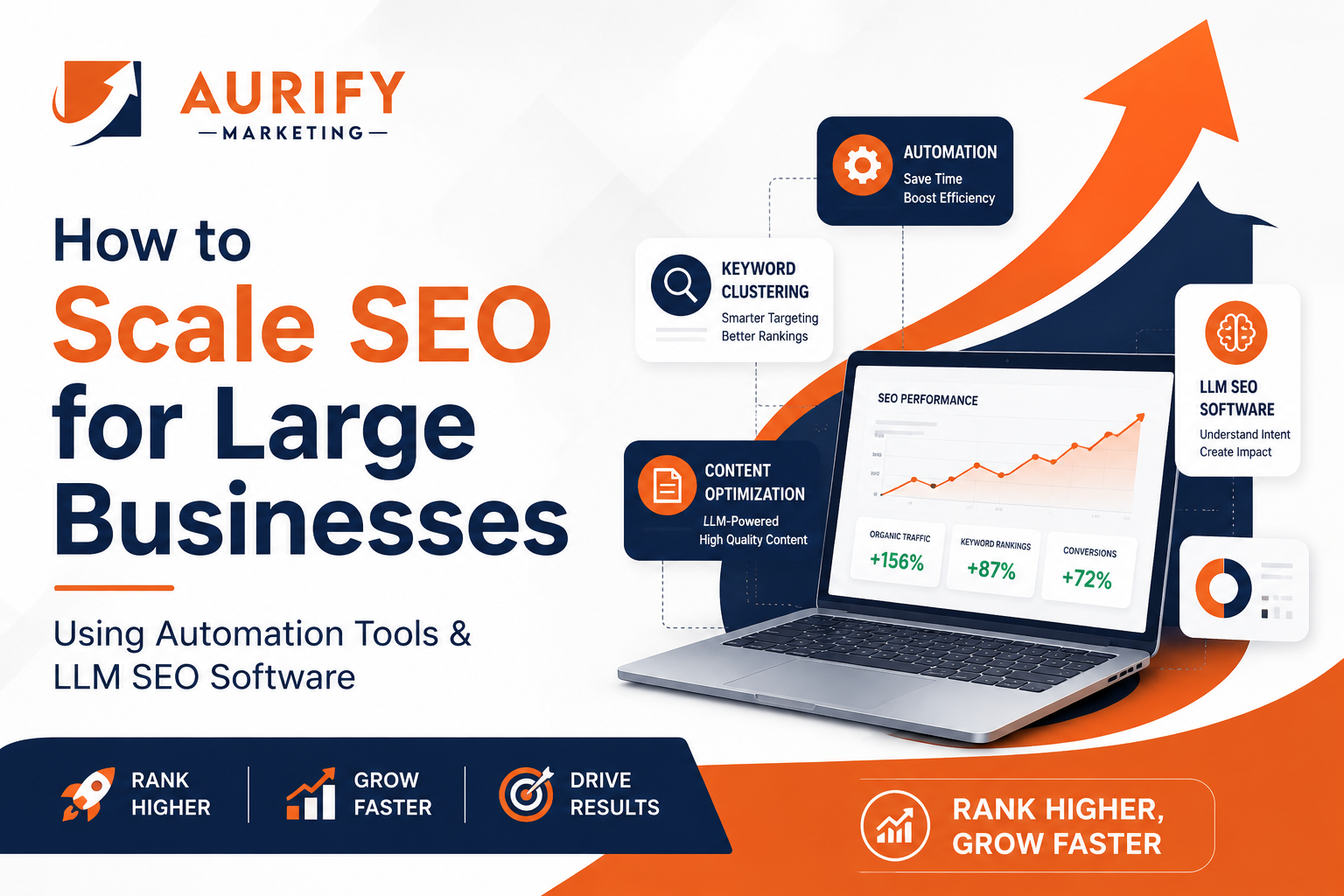
Modern SEO marketing by Aurify Marketing showcasing automation tools, LLM SEO software, and business growth with bold “Rank Higher, Grow Faster” messaging and digital analytics visuals.
Scaling SEO for large businesses is not about doing more manual work. It is about building systems that handle complexity, volume, and continuous optimization without slowing down. Enterprise websites often contain thousands to millions of pages, multiple teams, and constant content updates. Without automation and intelligent analysis, SEO becomes inconsistent and inefficient.
This guide explains how to scale SEO using automation tools and LLM (Large Language Model) SEO software with clear strategies, workflows, and execution steps.
Why Traditional SEO Fails at Scale
Large businesses face challenges that small websites do not. These include massive number of pages, multiple stakeholders and departments, frequent product or content updates, technical SEO complexity, and global or multilingual targeting.
Manual SEO processes cannot keep up. Updating metadata, auditing pages, and analyzing keywords manually leads to delays and missed opportunities.
Scaling requires automation for repetitive tasks, centralized data analysis, and AI-driven content and optimization.
What Is SEO Automation
SEO automation uses tools and scripts to handle repetitive SEO tasks without manual input.
Key areas of automation include technical audits, keyword tracking, internal linking, metadata generation, reporting and dashboards, and content optimization.
Automation reduces human error and improves efficiency while allowing teams to focus on strategy.
What Is LLM SEO Software
LLM SEO software uses advanced AI models to analyze, generate, and optimize content based on search intent, semantics, and user behavior.
Capabilities of LLM SEO tools include generating SEO-optimized content, improving keyword relevance, analyzing search intent, suggesting topic clusters, optimizing readability and structure, and creating meta tags and schema.
LLMs help businesses move beyond keyword stuffing toward semantic SEO.
Core Strategy to Scale SEO
Scaling SEO requires a structured approach.
Build a Strong Technical Foundation
Before automation, ensure your website is technically sound.
Key areas to fix include crawlability, indexing issues, site speed, mobile optimization, Core Web Vitals, and URL structure.
Automation can be used to identify broken links, detect duplicate content, and monitor indexing issues. Automated alerts should be set for critical errors.
Automate Keyword Research and Clustering
Large businesses target thousands of keywords across categories.
Manual keyword research is time-consuming, inconsistent, and often misses semantic connections.
Automation helps extract large keyword datasets, cluster keywords based on intent, and identify long-tail opportunities.
LLM tools understand context rather than just keywords. They group topics based on meaning and suggest related queries, which improves topical authority.
Create Scalable Content Systems
Content creation is one of the biggest bottlenecks.
Traditional methods are slow, inconsistent, and difficult to scale.
A scalable content model starts with defining content templates such as blog posts, landing pages, product descriptions, and category pages.
LLM tools can generate first drafts, create outlines, and expand sections. A human editing layer ensures accuracy, expertise, and tone. This hybrid model balances speed and quality.
Automate On Page SEO Optimization
On page SEO becomes complex with thousands of pages.
Automation can handle title tags, meta descriptions, header structure, image alt text, and internal linking.
LLM tools generate optimized titles at scale, improve keyword placement, and maintain natural readability.
Internal Linking at Scale
Internal linking improves crawlability and ranking.
Manual linking is inconsistent and limited.
Automation helps suggest relevant internal links, insert links based on keywords, and maintain a proper link hierarchy.
This improves page authority distribution, indexing, and user navigation.
Automate Technical SEO Monitoring
Enterprise websites change frequently, so monitoring must be continuous.
Automation can track broken pages, redirect issues, indexing problems, and page speed drops.
Dashboards help track traffic, rankings, errors, and conversions in one place.
Use LLMs for Content Optimization
LLMs are effective for improving existing content.
They enhance search intent alignment, readability, semantic relevance, and content depth.
Content improvements include expanding thin pages, adding FAQs, improving structure, and including related topics.
Scale SEO Across Multiple Locations
Large businesses often target multiple regions.
Challenges include duplicate content, localization issues, and keyword variations.
Automation helps generate location-based pages, customize content dynamically, and optimize for local keywords.
LLMs adjust tone and language while maintaining consistency and avoiding duplication.
Automate Reporting and Analytics
Manual reporting takes time and slows decision-making.
Automation provides reports on keyword rankings, traffic growth, page performance, and conversions.
This enables real-time insights, faster decisions, and clear ROI tracking.
Build a Scalable SEO Workflow
A structured workflow ensures consistency.
The process includes keyword clustering, content generation, on page optimization, publishing, internal linking, monitoring, and reporting.
Best SEO Automation Tools Categories
Instead of relying on one tool, businesses should use a stack.
This includes technical SEO tools for crawling and analysis, keyword tools for clustering and trends, content tools for AI writing and optimization, and analytics tools for tracking performance.
Benefits of Using Automation and LLM SEO
Automation increases speed by completing tasks faster than manual work.
It ensures consistency across pages and enables scalability without increasing workload.
It provides better insights through AI-driven analysis and reduces operational costs.
Common Mistakes to Avoid
Over automation without human review reduces quality.
Ignoring search intent leads to poor rankings.
Duplicate content harms SEO performance.
Lack of strategy limits the effectiveness of tools.
Future of SEO AI and Automation
SEO is evolving toward semantic search, AI-driven content, voice queries, and personalized results.
LLMs will play a central role in understanding user intent, generating content, and automating optimization.
Businesses adopting these technologies early will gain a competitive advantage.
Conclusion
Scaling SEO for large businesses requires systems rather than manual effort. Automation tools handle repetitive tasks, while LLM SEO software adds intelligence and adaptability. This combination enables faster execution, better content, and consistent optimization.
Businesses that implement Aurify marketing structured workflows, automation, and AI-driven insights can achieve long-term SEO growth without increasing complexity.